
artEmis

Awareness and resilience
through European multi sensor system
A Euratom H2022 research project
artEmis
Awareness and resilience through European multi sensor system

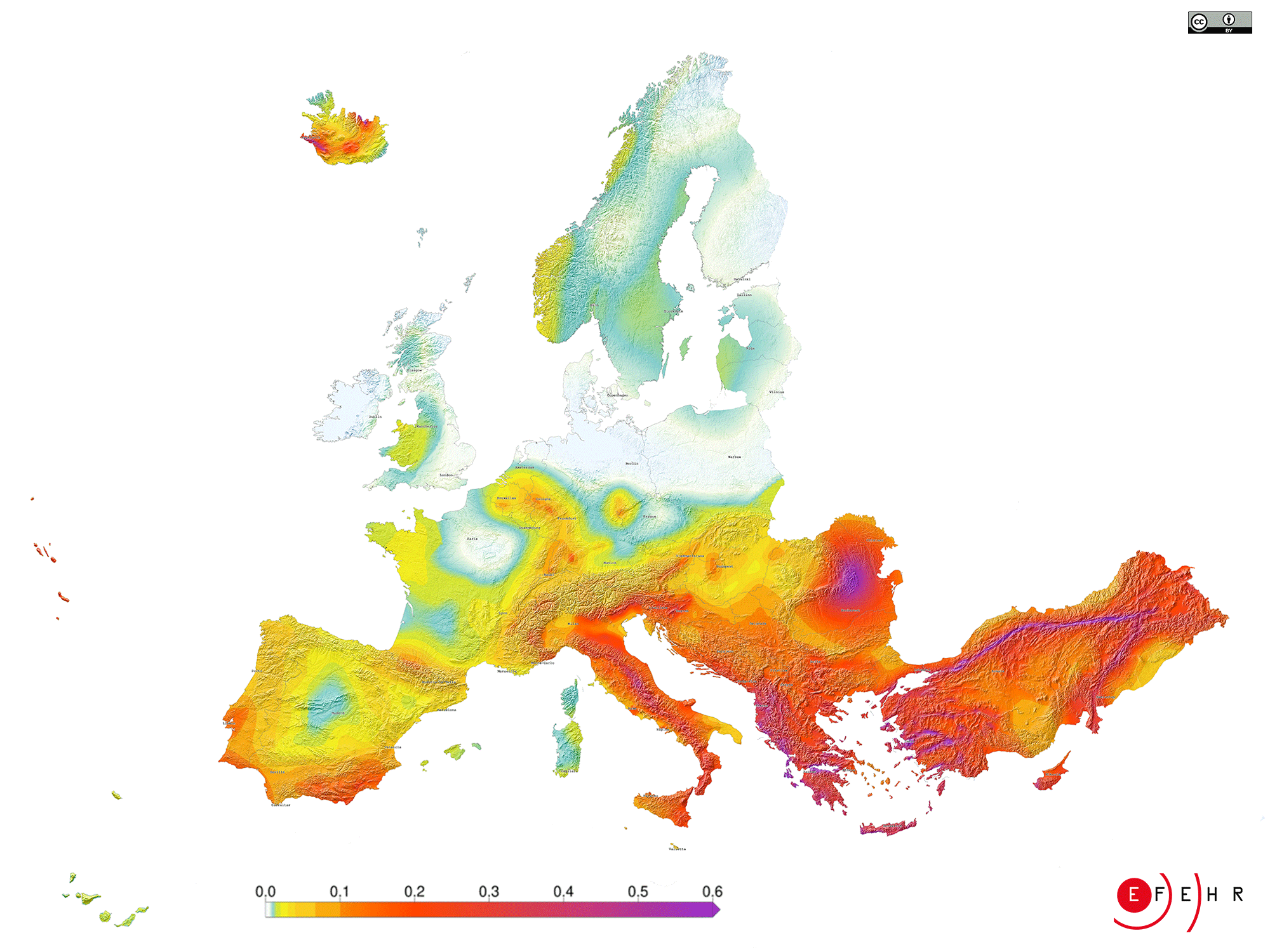
Danciu L., Nandan S., Reyes C., Basili R., Weatherill G., Beauval C., Rovida A., Vilanova S., Sesetyan K., Bard P-Y., Cotton F., Wiemer S., Giardini D. (2021). The 2020 update of the European Seismic Hazard Model: Model Overview. EFEHR Technical Report 001, v1.0.0, https://doi.org/10.12686/a15

Scientific Background

Artemis will place over 100 sensors for radon detection and measurements along fault zones in earthquake prone areas in Greece and Italy, and a minor set along the Swiss Alps. Radon emission and variations in concentration has since long been proposed and used as an earthquake precursor. One will find over 600 publications when searching for radon as an earthquake precursor. There are several problems associated with radon measurements published in the literature: a large set of measurements have been performed in air or soil, that carry substantial uncertainties due to large variations of the natural background. Other reports rely on rather large distances between measurements sites and the epicenter, uncertain time window etc.

The present project will shed light on many issues related to radon measurements and analysis, by (i) measuring radon with a high spatial resolution due to the large number of sensors, (ii) measurements in groundwater in real time, and (iii) by deploying advanced data analysis via machine learning algorithms.

ArtEmis’ ultimate aim is to improve earthquake forecasting. While it is possible to forecast earthquakes in specific regions (e.g. an earthquake of a certain magnitude will occur in the next 50 years at a certain location with a certain probability), with present knowledge, predictions of earthquakes (i.e. when and where exactly an earthquake is going to occur) are not possible. However, using the definition accepted in literature by Max Wyss* (see below), requiring accurate information about the location within a certain radius, estimation of the magnitude and a time window when an earthquake will occur, we will be able to test our precursor signals against short-term predictions of earthquakes.

An important aim of artEmis is to provide new/novel knowledge about the quantitative relation of various proxies that can act as precursors, that are to be measured in groundwater, and to correlate these data to subsequent earthquakes. Since the likelihood of a large earthquake during the duration of the project is not very high, information gathered on the relation of potential precursors to seismic activity will be somewhat limited. Hence, one needs to realize that artEmis will require continuation and if possible, expansion for further advancement of our knowledge. Provided the artEmis sensor system is working well, members of artEmis will engage to find financial support for the continuation and expansion of the network, as outlined in the communication and dissemination strategy.

Read the full description

Scientific results


PUBLIC DELIVERABLES

DELIVERABLE 1.1 ARTEMIS D1.1

DELIVERABLE 1.2 ARTEMIS D1.2

DELIVERABLE 2.1 ARTEMIS D2.1

DELIVERABLE 2.2 ARTEMIS D2.2

DELIVERABLE 2.3 ARTEMIS D2.3

DELIVERABLE 2.4 ARTEMIS D2.4

DELIVERABLE 2.5 ARTEMIS D2.5

DELIVERABLE 2.6 ARTEMIS D2.6

DELIVERABLE 2.7 ARTEMIS D2.7

DELIVERABLE 2.8 ARTEMIS D2.8

DELIVERABLE 2.9 ARTEMIS D2.9

DELIVERABLE 3.1 ARTEMIS D3.1

DELIVERABLE 3.2 ARTEMIS D3.2

DELIVERABLE 3.3 ARTEMIS D3.3

DELIVERABLE 4.1 ARTEMIS D4.1

DELIVERABLE 6.1 ARTEMIS D6.1

PUBLICATIONS

Crowley H., Dabbeek J., Despotaki V., Rodrigues D., Martins L., Silva V., Romão X., Pereira N., Weatherill G., Danciu L. (2021). European Seismic Risk Model (ESRM20), EFEHR Technical Report 002, V1.0.0, 84 pp, https://doi.org/10.7414/EUC-EFEHR-TR002-ESRM20


Kumar et al., Earthquake precursor measurements employing a network of radon sensors, EPJ Nuclear Sci. Technol. 11, 48 (2025) https://doi.org/10.1051/epjn/2025045


Tallini et al., Selection of hydrosensitive to seismicity sites for radon monitoring in the Abruzzo aquifers (central Italy) within the European ArtEmis project, Physics and Chemistry of the Earth, 141(2025) 104127 https://www.sciencedirect.com/science/article/pii/S1474706525002773?via%3Dihub2


Guerriero, V., & Tallini, M. (2025). Power law distribution and multi-scale analysis in Earth sciences, finance, and other fields: Some guidelines to parameter estimation. Chaos: An Interdisciplinary Journal of Nonlinear Science 36(6) May 25, https://doi.org/10.1063/5.0259215.


Stoulos et al., Radon signals in soil gas associated with earthquake occurrence in Greece: review and perspective, Journal of Radioanalytical and Nuclear Chemistry (2024) 333:6107–6120 https://link.springer.com/content/pdf/10.1007/s10967-024-09710-4.pdf


 Bountzis et al., Triggering Mechanisms and Repeating Earthquakes during the Intense 2020 – 2021 Seismic Crisis in the Gulf of Corinth. Geophys. J. Int. (2025) 242, 1–18. https://doi.org/10.1093/gji/ggaf181


 Isaya et al.,  Hydroseismograms at Gran Sasso aquifer, central Italy, for earthquake hydrology studies. Sci Rep (2025) 15:13162 https://doi.org/10.1038/s41598-025-96113-4


 Anagnostou et al.,  Investigating the 2024 Swarm–Like Activity Offshore Kefalonia Island, Aided by Machine Learning Algorithms. Pure Appl. Geophys. 2025 https://doi.org/10.1007/s00024-025-03766-3


Bonatis et al., The 2022 Mw5.5 earthquake off-shore Kefalonia Island – relocated aftershocks, statistical analysis and seismotectonic implications. Journal of Seismology (2024). https://doi.org/10.1007/s10950-024-10255-y


Kourouklas et al., Long-Term Recurrence Pattern and Stress Transfer along the Kefalonia Transform Fault Zone (KTFZ), Greece: Implications in Seismic Hazard Evaluation. Geosciences 2023, 13, 295 https://doi.org/10.3390/geosciences13100295 


Kourouklas et al.,  Large Earthquakes Recurrence Time in the Kefalonia Transform Fault Zone (KTFZ), Greece: Results from a physics-based simulatorapproach. Annals of Geophysics, Vol. 66 No. 5 (2023). https://doi.org/10.4401/ag-8936


Ayşe Ataç Nyberg and Ramon Wyss, ArtEmis Projektet: Kärnfysik ock jordbävningar, Svenska Fysikersamfundet – Kosmos 2024. https://www.fysikersamfundet.se/wp-content/uploads/Kosmos-sartryck-2024-5-Nyberg300.pdf

WORK PACKAGES

WP1
Smart sensor unit, detector development and inte-gration, field design, GSI, Radontech, SURO, KTH, AUTh,JRC
WP2
Site Mapping, field studies natural background measurements, calibration, Univaq, AUTh, INGV, ETH.
WP3
Scalable sensor network architecture, KTH, GSI
WP4
Field tests and placement of sensor units a: Abruzzi, b: Ionian Islands, c: Swiss Alps.
AUTh, Univaq, ETH, INGV, KTH
WP5
Distributed Edge-AI integration and data analysis tools, SU, KTH.
WP6
Communication, dissemination, exploitation, continuation pilot project with municipalities, outreach to public bodies,
IESE, communita L’Aquila, association of municipalities of Ionian Islands, INGV, KTH, AUTh.

News and Events

ArtEmis PhD student Gururaj Kumar (KTH, GSI) has been awarded the “Best Student Presentation Prize” for his talk titled “Advances in Radon-Based Earthquake Forecasting Using Sensor Networking” at the NuPECC (Nuclear Physics European Collaboration Committee, European Science Foundation) XXXVIII Mazurian Lakes Conference on Physics, held in Piaski from 31 August – 6 September 2025.

In addition, his poster titled “Earthquake Precursor Measurements Employing a Network of Radon Sensors” was selected as Winning Poster No. 1 at the Juliet Curie Euroschool on Exotic Beams, held in Saint-Pierre d’Oléron, France, from 7–12 September 2025.


ARTEMIS Stakeholder and Science Workshops

June 17-19th, 2024
IESE Business School, University of Navarra, Barcelona, Spain

workshop information sheet


Partners

Newsletter

Please, download newsletter:

Newsletter #1

Newsletter #2

Newsletter #3

Contacts

Project Coordinator: Ayse Atac Nyberg, KTH

email: ayseatac@kth.se


Page updated on November 2025